I've Lived This Before: What Science Says About Déjà Vu
You walk into a new place and everything feels familiar down to the detail. You did not live that moment before: your brain just made a fascinating mistake.
You walk into a new place and everything feels familiar down to the detail. You did not live that moment before: your brain just made a fascinating mistake.

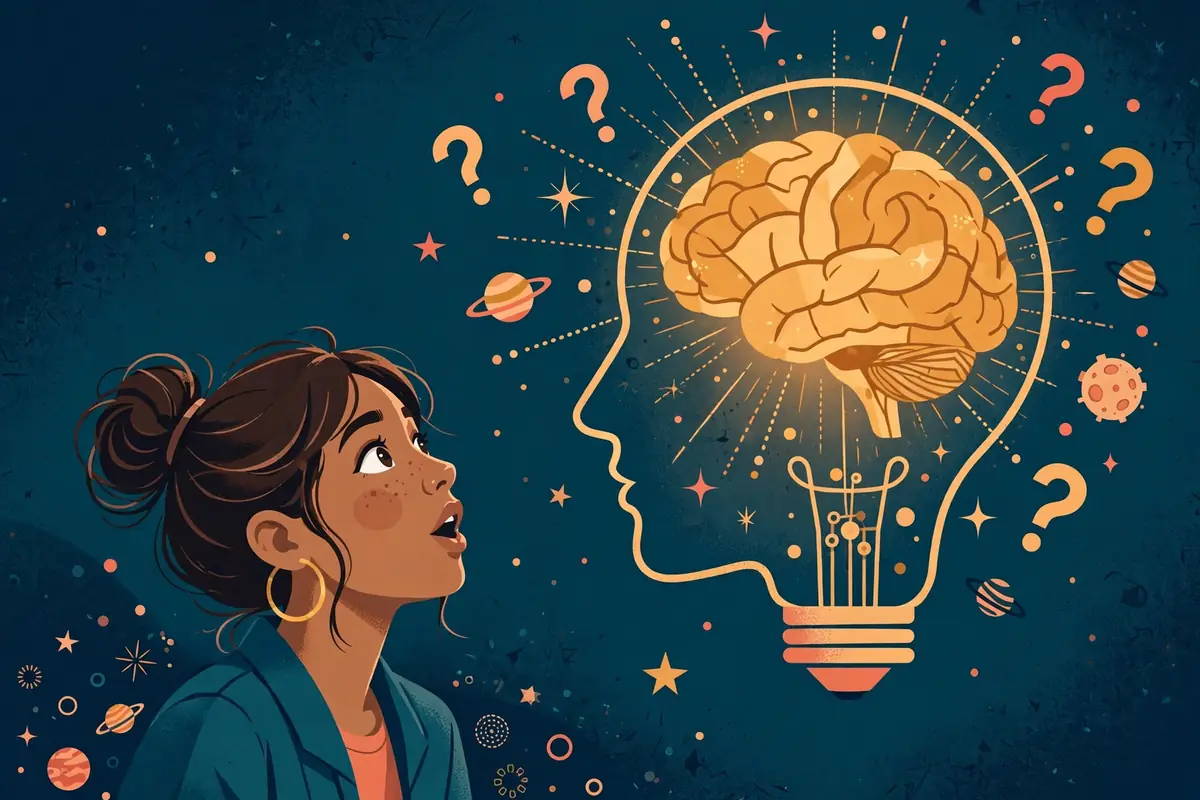
Original Curioso Latino illustration.
The scene is almost a script: you walk into a café you have never visited, the waiter sets the cup on the table, someone laughs three tables away… and suddenly a strange certainty runs through you: 'I have lived this'. It lasts a few seconds, it fades, and it leaves you feeling you brushed against something impossible. It is called déjà vu —'already seen', in French— and science has studied it for decades. It is not magic, nor a serious malfunction: it is a window into how your memory works.
Déjà vu is an intense feeling of familiarity toward something you know is new. It is not remembering: it is feeling that you remember, without being able to say what, when, or where. It usually lasts just a few seconds, and the vast majority of people have felt it at least once, more often when young, tired, or stressed.
The key point is this: the feeling comes with no content. If you had truly lived that moment, you could tell the story. In déjà vu there is no story: only the label 'known' stuck onto something new.
Your memory does not work with a single switch, but with two systems that normally work together: familiarity ('I know this') and recollection ('this is how it was'). Familiarity lives in the rhinal cortex, in the temporal lobe; recollection with context lives in the hippocampus.
The most accepted explanation is that, in déjà vu, the familiarity detector fires early, without the recollection system backing it up. The brain receives the 'known' signal with no evidence, and for a few seconds two contradictory truths coexist: 'this is new' and 'this already happened'.
Another classic explanation is dual processing: perception and memory process the same scene in parallel, and if one system runs a few milliseconds ahead of the other, the brain interprets that lag as a memory.
It is like watching a live broadcast with the audio half a second ahead: the brain tries to sync two versions of the same moment, and the result is the illusion of having lived it twice.
Most surprisingly, researchers can trigger déjà vu in the lab. Electrically stimulating the entorhinal cortex —the gateway between the senses and the memory centers— reliably produces the feeling, more than stimulating the hippocampus.
And there is a revealing experiment: psychologist Anne Cleary showed in 2012 that a new scene can feel familiar if it shares the structure of one seen before —the same room layout, for example— even if you do not remember the original. Your brain recognizes the pattern without recognizing the source.
The most elegant finding came from MRI: during induced déjà vu, the memory-retrieval areas do not activate; instead, the frontal conflict-detection areas do. In other words: your brain is not retrieving anything; it is detecting its own error and correcting it live.
That is why researchers describe it as a sign of a healthy system, not a failure: déjà vu is proof that your memory's quality control works. The wrong label lasts seconds because the system reviews it and discards it.
Researchers distinguish occasional déjà vu —which they consider a normal quirk of the memory system— from frequent, intense, or prolonged episodes, which they study in a neurological context: in people with temporal lobe epilepsy, déjà vu can appear as an aura before a seizure.
That distinction is useful: an occasional déjà vu is your brain doing its job with a small stumble. If such a phenomenon worries you or repeats a lot, the sensible path is to mention it to a health professional, not to look for hidden meanings in it.
Déjà vu is not that you lived that moment: it is your brain live-correcting a labeling error.
For exploring how your mind tricks you (and protects you).
David Eagleman explains your mind like nobody else: clear, fun, and surprising.
See on AmazonFor your favorite podcasts and audiobooks with no interruptions.
See on AmazonReviewed by the Curioso Latino editorial team. Original content for entertainment and general culture purposes.
Did you like this content? Give it a like! ❤️