Why the music of your teenage years gives you goosebumps: what science says
A study of 2,000 people across 84 countries found that the most meaningful music of your life was discovered around age 17. Here's what happened in your brain.
A study of 2,000 people across 84 countries found that the most meaningful music of your life was discovered around age 17. Here's what happened in your brain.
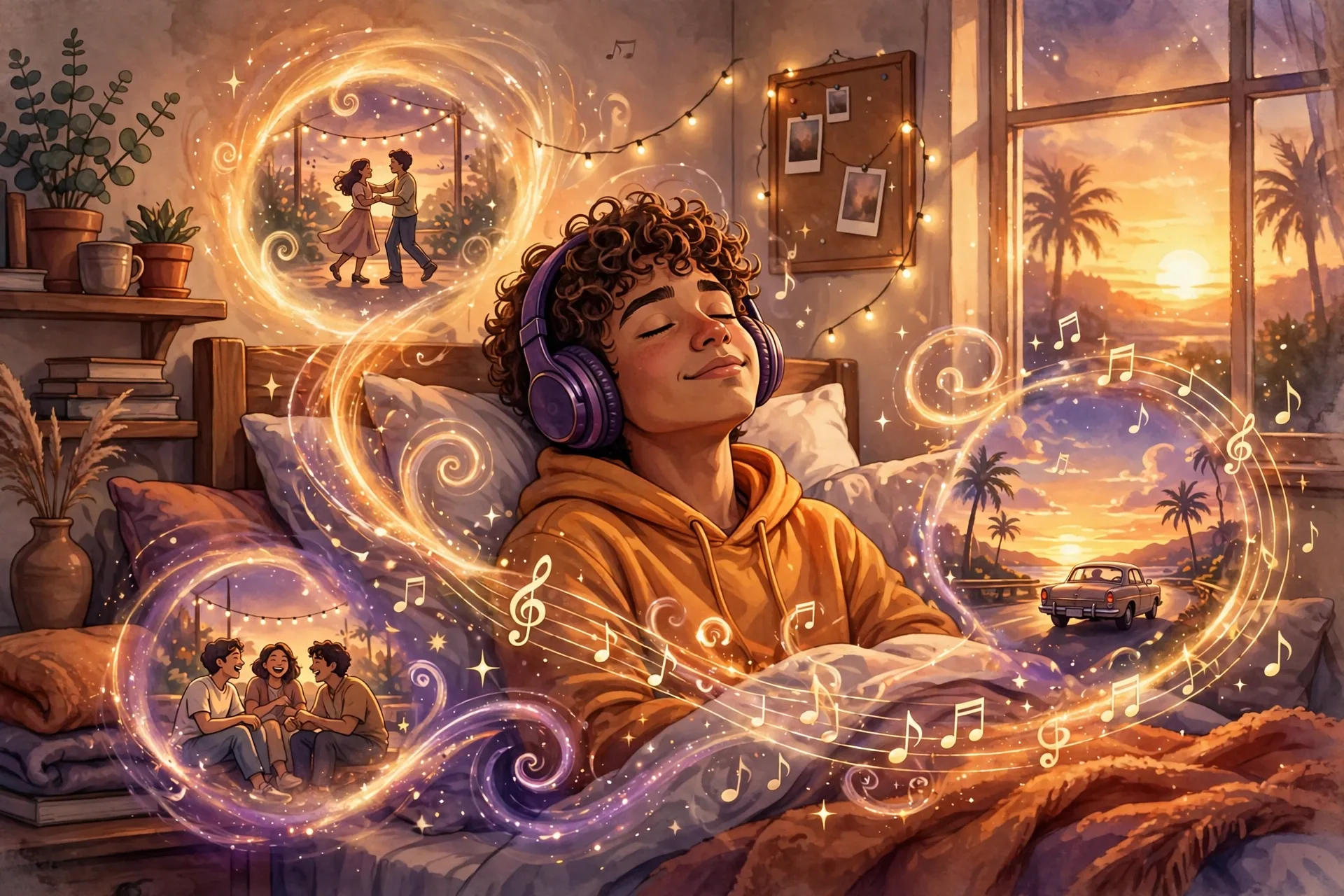
Original Curioso Latino illustration.
The first chord plays and something runs down your spine: that song from when you were 17, the one from your first love, the car rides with friends, the goodbye you never forgot. Twenty years have passed, you've heard thousands of songs since… and none moves you like that one. It's not coincidence or simple nostalgia: your teenage brain burned it in for a reason. Science has now found out why.
In 2025, Dr. Iballa Burunat and her team at the University of Jyväskylä in Finland asked some 2,000 people across 84 countries what the most meaningful music of their lives was. The answer repeated over and over: they discovered it around age 17. Psychologists call it the reminiscence bump: the stretch between ages 10 and 30 leaves the deepest marks on memory, and adolescence is its peak.
At that age your brain is under full construction: neuroplasticity — its ability to reshape itself — is at its highest, and everything is felt for the first time. Every emotion arrives in high definition. That's why a song heard at 17 isn't “just another song”: it's the first time you felt that, with that music in the background.
When your favorite teenage song plays, your brain fires up the reward system: it releases dopamine, the same pleasure chemical that shows up with good food or a hug. The shivers — the famous frisson — are the physical signal that your nervous system is saying “this matters”.
This isn't cheap nostalgia: it's neurochemistry. The music that marked you is wired into your pleasure circuits permanently, like a highway your teenage brain built and never tore down. That's why a 20-year-old stranger can cry to a 90s ballad that's “not from their era”: the highway works the same.
Strong emotions act as memory glue. When you live something intense — the first kiss, the first goodbye, the night that changed everything — your amygdala (the emotion hub) tells your hippocampus (the memory archive): “save this, it's important”. And if there was music playing, the music gets saved with the whole package.
Every song from your teens was filed next to a moment of your life. That's why a chord teleports you: you're not remembering the song, you're reopening the file. The music is the key; the memory is the room.
At 17, music wasn't just sound: it was identity and belonging. Your genre said who you were, who you hung out with, what you believed. The rocker, the salsera, the rapper, the pop girl: every tribe had its anthem, and singing it meant saying “I'm one of these”.
Those songs are the anthem of your forming self. That's why defending your music feels like defending yourself: you're not arguing about chords, you're arguing about who you were. And that's why, when “your” song plays at a party 20 years later, everyone from your generation screams along: it's a reunion with the tribe.
There's an observation caregivers and families report again and again: in advanced dementia, when almost all memories are gone, teenage music is often among the last things to fade. People who no longer recognize their children hum complete the songs from their 17.
Maybe it's because those songs don't live only in memory: they live in identity, in layers of the brain that forgetting reaches last. So take care of your soundtrack: it's not just a playlist, it's your autobiography written in chords. And next time your skin prickles, don't ask why: be grateful.
Back to your 17 with the ears they deserve.
The neuroscientist who explains why music moves us: from Mozart to your age-17 playlist.
See on AmazonRelive your teenage soundtrack with the sound it deserves.
See on AmazonReviewed by the Curioso Latino editorial team. Original content for entertainment and general knowledge.