Fun Facts
Why Your Brain Invents Memories That Never Happened
You remember it in total clarity: the trip, the conversation, the detail. There's just one problem: it never happened. Your memory isn't a camera, it's a novelist. And science has been catching it red-handed for decades.
✍️ Curioso Latino Team📅 Published: October 23, 2026⏱️ 6 min read
Original Curioso Latino illustration.
As an Amazon Associate I earn from qualifying purchases.
You argue with your sibling about a childhood memory. You see it crystal clear: grandma's house, the rainy afternoon, the dog running across the yard. They see it just as clearly... but in their version the dog was a different color and it rained at a different house. One of you is making it up. Science says something uncomfortable: probably both of you.
Welcome to false memories: memories that feel 100% real and yet never happened —or didn't happen that way.
Your memory isn't a camera: it's an editor
We like to believe remembering is like opening a saved video. But psychology has shown that remembering is more like reconstructing: every time you bring a memory to mind, your brain takes it apart and rebuilds it... and with each rebuild it can swap pieces without telling you.
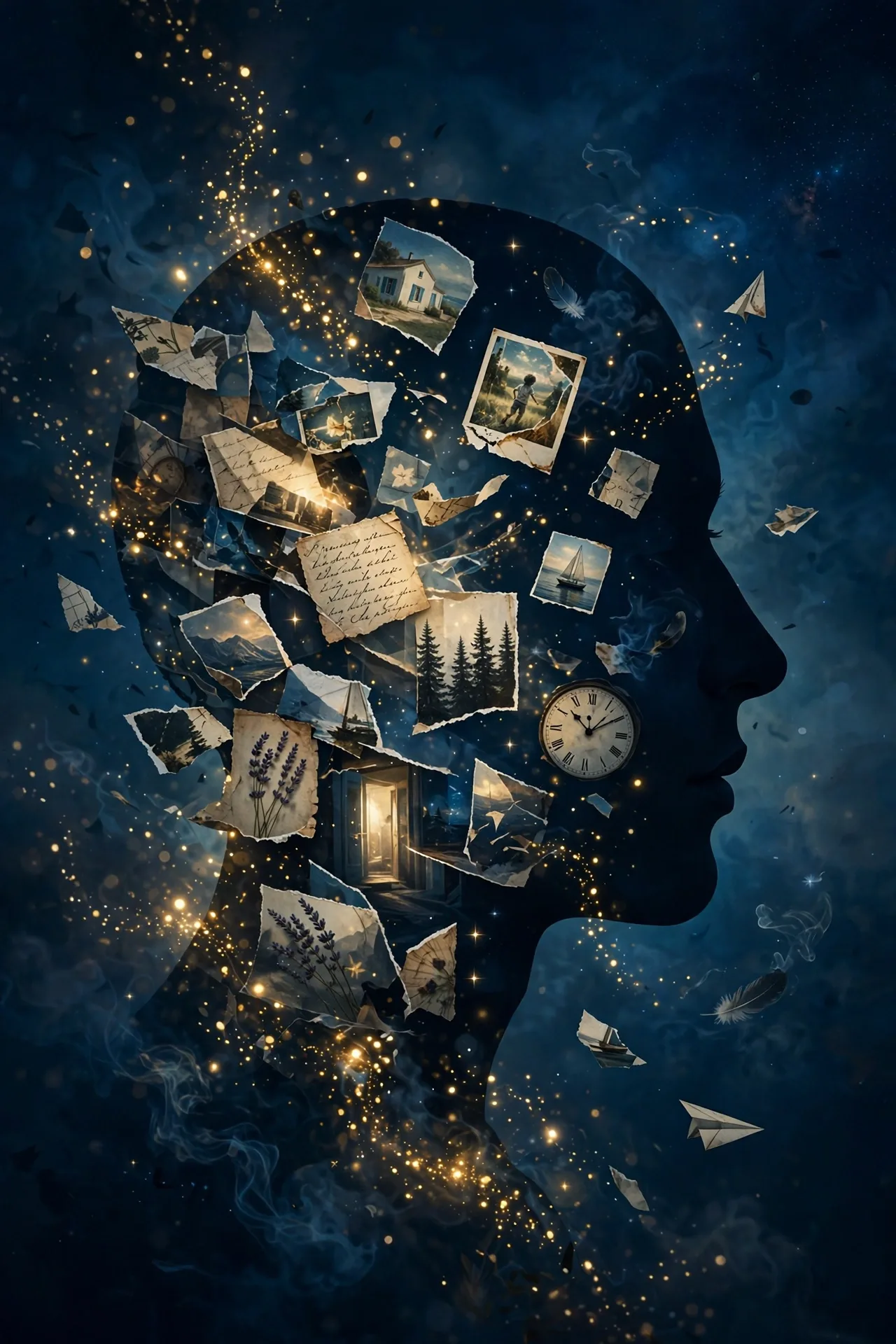
The brain hates gaps. If it only kept fragments of an event, it fills the rest with logic, with things that happened on another occasion, with what people told you later. The result feels like a perfect memory. It isn't: it's a collage.
The experiment that proved it all
In the 1990s, psychologist Elizabeth Loftus ran a legendary experiment: she told participants a story from their childhood —that as kids they had gotten lost in a shopping mall— completely invented with help from their families. After a few rounds of questions, about one in four began to "remember" the event: they described details, emotions, even the kind stranger who supposedly helped them.
None of it had happened. Their brains had fabricated it from suggestion mixed with real fragments. If a false memory can be planted that easily in a lab, imagine what decades of family stories repeated at every gathering can do.
Why your brain does this
It's not a flaw: it's the price of an efficient system. Your brain keeps the essentials and rebuilds the rest because remembering everything would be impossible. Plus, memory isn't just for the past: it's for imagining the future, and it uses the same "workshop" for both. That creative flexibility is what sometimes invents.
Photos are perfect accomplices: you see an old photo so many times you end up "remembering" the moment... when really you remember the photo. The same goes for family anecdotes: after hearing one 20 times, your brain files it as a personal experience.
How to spot an invented memory
There are typical signs: the memory is too cinematic, with exact dialogue from 20 years ago (suspicious: memory almost never keeps literal dialogue); you "see" it from outside, as if you were a spectator rather than the protagonist; or it appeared out of nowhere after someone told you their version.
None of these signs proves anything on its own. But if two people remember the same thing differently, the likeliest explanation isn't that one is lying: it's that both reconstructed.
Don't distrust your memory: thank it for the effort. Just remember that sometimes it tells you stories... and it tells them very well.