Day of the Dead vs Halloween: 8 differences almost nobody explains
Same weekend, two opposite worlds: one celebrates life, the other plays with fear. 8 differences between the ofrenda and the jack-o'-lantern.
Same weekend, two opposite worlds: one celebrates life, the other plays with fear. 8 differences between the ofrenda and the jack-o'-lantern.
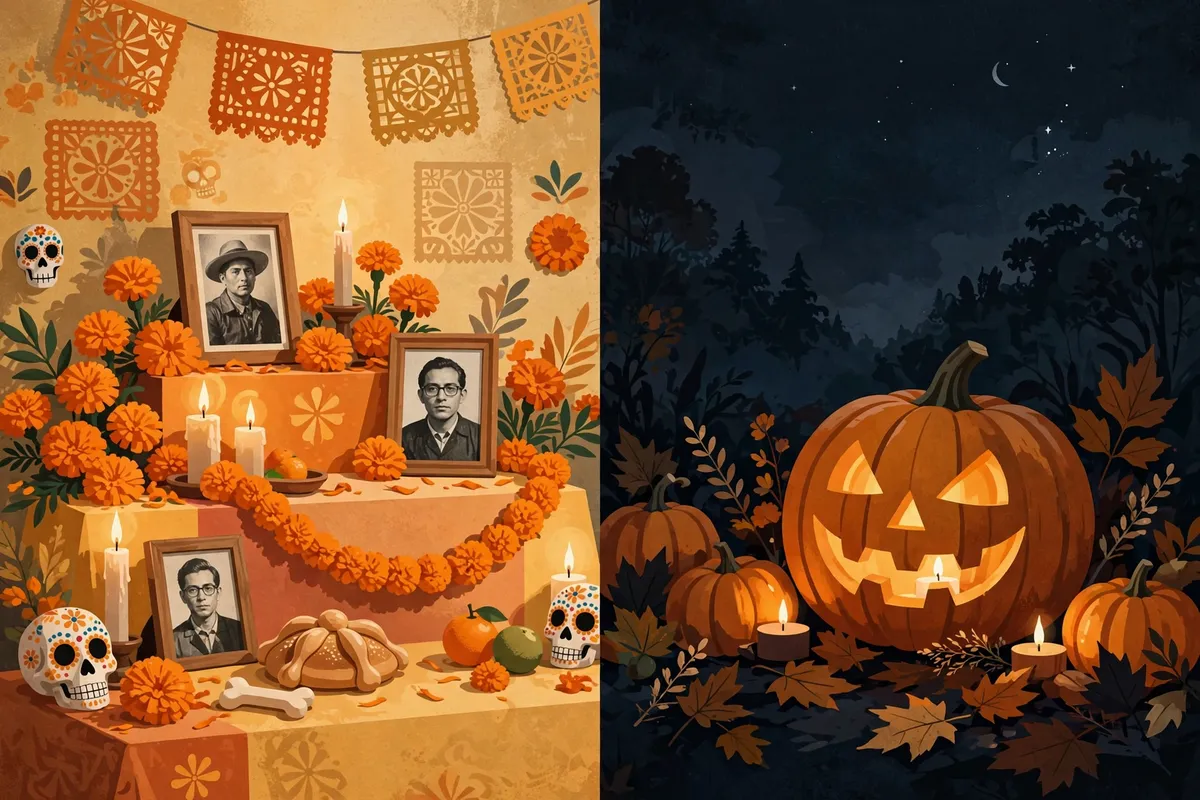
Original Curioso Latino illustration.
They get confused because they land on the same weekend and both use skulls, candles, and costumes. But the Mexican ofrenda and the spooky night are two celebrations with almost opposite roots, purposes, and symbols. Here are 8 differences that set each one in its place.
Halloween is celebrated on October 31: a single night. The Day of the Dead, by contrast, takes up November 1 and 2: the first day is dedicated to children, the "angelitos"; the second, to adults. And the ofrenda is not thrown together in an afternoon: many families start preparing days ahead, with shopping, flowers, and cooking.
Halloween descends from Samhain, the Celtic feast marking the end of the harvest and the start of winter, when the line between the living and the dead was believed to thin. That tradition, blended with Christianity, grew in Ireland, Scotland, and Great Britain, then crossed the Atlantic to become the nighttime celebration we know today in North America.
The Mexican celebration comes from Mesoamerican cultures, which venerated the dead and believed their souls returned to spend time with the living. The journey to Mictlán, the land of the dead, was honored with offerings to Mictlantecuhtli and Mictecacíhuatl, the lords of that realm. With the arrival of Christianity, that tradition merged with the Catholic calendar of November 1 and 2: All Saints' Day and All Souls' Day.
Here is the deepest difference. Halloween plays with fear and the supernatural: the dead are the scare, the danger, the party of the dark. The Day of the Dead is the opposite: a joyful, family memory, a celebration of the lives of those who are gone. Nobody builds an ofrenda to be scared; they build it to remember, to laugh, and to share.
Halloween is recognized by the carved pumpkin face (the jack-o'-lantern), costumes, ghosts, witches, bats, and its black-and-orange palette. The Day of the Dead has its own universe: the ofrenda or altar, the marigold (cempasúchil) that guides spirits with its color and scent, candles, photos of the departed, their favorite food, sugar skulls —which are humor, not fright—, papel picado, and La Catrina, born as satire and turned into a cultural icon reminding us that before death we are all equal.
On Halloween, candy travels from the house to the kids at the door: the classic "trick or treat." On the Day of the Dead, it travels the other way: the living place it on the ofrenda for the dead, and once the celebration is over, the family eats it. Some candies are asked for; the others are offered.
The Halloween costume serves to hide the person: becoming something else for one night. The painted skull of the Day of the Dead does the reverse: it imitates the dead, affectionately mocks death, and began as a joke about the living. One hides the face; the other celebrates it turned into a skull.
Halloween owns the street and the front door: you go out, you knock, you parade. The Day of the Dead owns the home altar and the tomb: the heart of the celebration is the visit to the cemetery, where families spend the night beside their dead. One party goes out into the street; the other returns home and to the graveyard.
And one closing nuance: both celebrations hang from the same Catholic hinge of November 1 and 2. They are "cousins, not strangers." Today in Mexico they are celebrated almost at the same time, and there is no need to choose between them: films like Coco carried the ofrenda to the whole world, while the pumpkin still rules the night of the 31st.
Halloween invites you to be afraid; the Day of the Dead invites you to remember. Two parties, one shared certainty: nobody leaves for good.
Fitting ideas to celebrate the season in full traditional style.
To understand the ofrenda and November's festivities beyond the surface.
See on AmazonWarm light for the altar or for setting the mood on the night of the 31st.
See on AmazonReviewed by the Curioso Latino editorial team. Original content for entertainment and general knowledge.